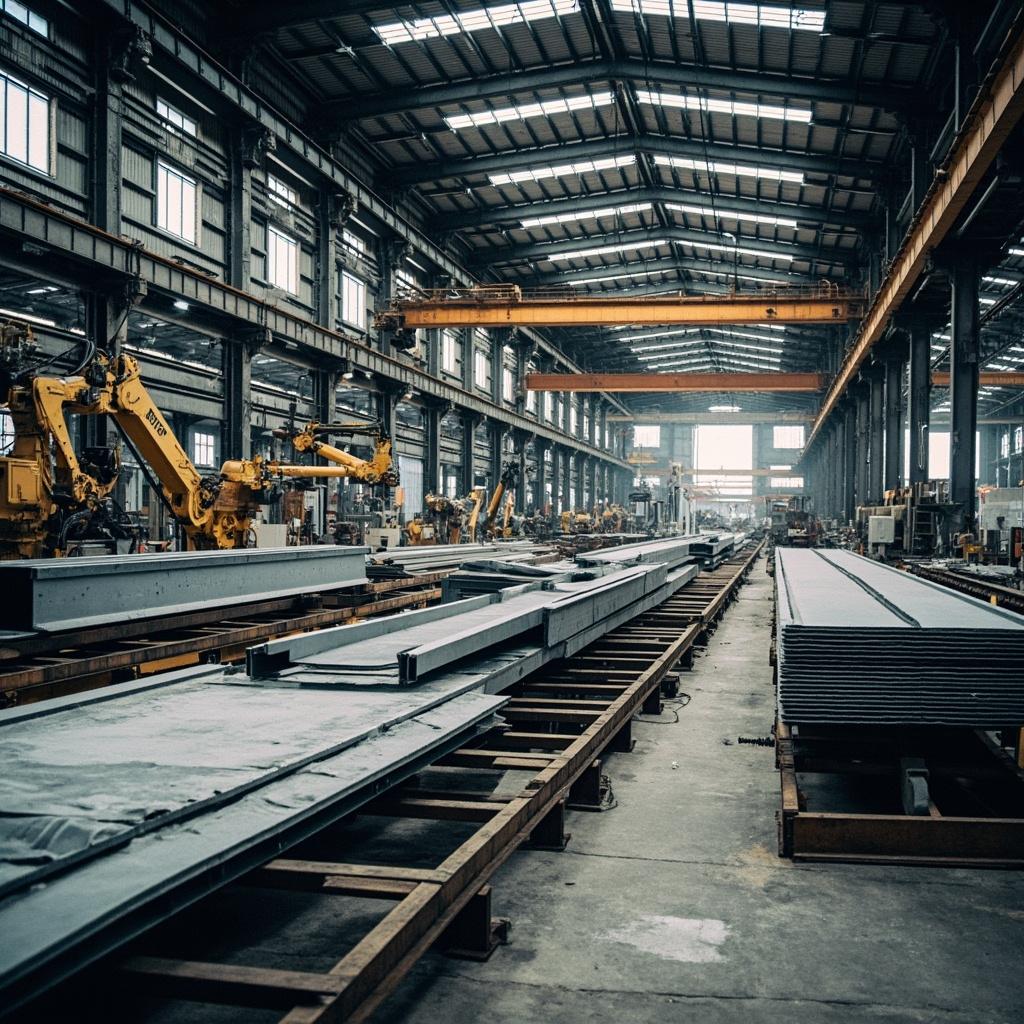
The global mechanical power transmission component manufacturing landscape is defined by intense regional specialization, accelerating cross-border consolidation, and a fundamental technology-driven transformation of what it means to be a "manufacturer" in this industry. Asia-Pacific dominates with 42.5% of global market share and explosive growth rates (China 6.1% CAGR, South Korea 5.4% CAGR), while European and North American manufacturers maintain technological leadership through advanced automation and industrial IoT integration.
Regional Manufacturing Power Centers
• Japan — Precision Manufacturing Fortress: Japan hosts four of the world's top ten manufacturers — JTEKT, NSK, NTN, and Tsubakimoto Chain — who collectively operate over 200 dedicated manufacturing facilities worldwide. Japanese manufacturers excel at ultra-high-precision processes where defect rates are measured in single-digit parts per million. NSK's 0.1-micron machining capability for semiconductor equipment bearings and JTEKT's closed-loop machine-tool-to-bearing quality system represent manufacturing capabilities that cannot be replicated through capital expenditure alone — they require decades of accumulated process knowledge and a manufacturing culture that treats quality as a moral imperative. However, Japan's demographic crisis (aging workforce, declining domestic manufacturing population) and strong yen create persistent competitive headwinds that are driving the historic NSK-NTN merger.
• Europe — High-End Engineering Powerhouse: Germany alone hosts two manufacturing titans — Schaeffler (70+ global plants, 120,000+ employees) and SEW-Eurodrive (18 core plants + 92 assembly centers) — alongside Sweden's SKF (108 manufacturing units). European manufacturers dominate high-margin, application-engineered components for demanding industries: wind turbine main shaft bearings, high-speed rail traction motor bearings, and aerospace precision gears. The structural challenge for European manufacturing is energy costs — German industrial electricity prices are 3-4x higher than US and Chinese equivalents, forcing continuous efficiency improvement in energy-intensive forging and heat treatment operations. Schaeffler's 4,700-position European workforce reduction and plant closures in Austria and the UK reflect the pressure to maintain manufacturing cost competitiveness while preserving engineering quality.
• North America — Integration and Digital Manufacturing: Regal Rexnord and Timken anchor US manufacturing, both executing aggressive acquisition strategies to build comprehensive production portfolios. North American manufacturers are at the forefront of integrating digital technologies into traditional metalworking — Regal Rexnord's E-Pod data center power management systems and Timken's CGI precision motion acquisition for medical robotics illustrate the crossover between heavy industrial manufacturing and digital infrastructure. The IRA and CHIPS Act-driven US manufacturing renaissance is creating massive domestic demand, but skilled manufacturing labor shortages remain the binding constraint on capacity expansion.
• China — Scale and Speed: Wanxiang Qianchao represents China's manufacturing ascent with 6 km² of production campuses, 1,000万+ annual universal joint capacity, and an audacious 1.2 million-unit robot bearing production target. Chinese manufacturers benefit from unmatched domestic market scale, government industrial policy support, and rapidly improving quality systems. The critical question for procurement organizations is whether Chinese manufacturers can close the remaining gap in metallurgical consistency and ultra-precision process control — a gap that traditionally requires decades, not years, of accumulated manufacturing data.
Five Transformative Manufacturing Trends
1. Aggressive M&A-Driven Manufacturing Consolidation. The industry is entering an era of "scale or perish." Regal Rexnord spent ~$5 billion acquiring Altra Industrial Motion, adding massive US manufacturing capacity. Tsubakimoto Chain fully acquired Daido Kogyo and Italian manufacturer EUROCATENA, consolidating chain production across three continents. Wanxiang Qianchao is acquiring Wanxiang America's manufacturing assets in the US, Mexico, Poland, and Turkey. This consolidation reflects the brutal economics of mechanical transmission manufacturing — where hundreds of millions in capital expenditure are required for a single new forging and heat treatment line, and only manufacturers with sufficient scale can afford the continuous reinvestment.
2. Regional Manufacturing Decoupling (Nearshoring). Tariff barriers are forcing a fundamental restructuring of global production footprints. SKF is restructuring its Americas manufacturing — closing some Mexican facilities while expanding others — to optimize for regional tariff structures. Wanxiang Qianchao is building production capacity in Thailand to serve Southeast Asian and tariff-exposed markets. Tsubakimoto Chain is establishing manufacturing in India and expanding Italian production through EUROCATENA. The era of "one factory serving the world" is over — replaced by a "factory in every major trade bloc" model that dramatically increases capital requirements and favors the largest manufacturers.
3. AI Data Centers as the New Heavy Industry. Hyperscale AI data center construction is creating an entirely new demand category for mechanical transmission manufacturing. Cooling pump drives, backup generator power transfer systems, and precision climate control actuation require specialized, high-reliability mechanical components. Regal Rexnord secured $735 million in data center power management orders in a single quarter — revenue that did not exist for mechanical transmission manufacturers five years ago. This crossover between digital infrastructure and mechanical manufacturing represents the most exciting growth frontier in the industry.
4. Humanoid and Industrial Robotics Manufacturing. The emerging robotics industry requires a new class of precision mechanical components — compact harmonic drives, high-torque-density cycloidal reducers, and ultra-thin cross-roller bearings — that push the boundaries of manufacturing capability. Wanxiang Qianchao has designated robotics as its third strategic business pillar, allocating 150+ R&D personnel and targeting 1.2 million units of annual robot bearing capacity. NSK is commercializing 0.1-micron precision bearings for surgical robots. This market, currently measured in hundreds of millions, could exceed $20 billion by 2035.
5. From Metalworking to Data Services. The most profound manufacturing transformation is the integration of sensors, connectivity, and AI into traditionally passive mechanical components. SKF's sensor-integrated bearings transform a mechanical component into a condition-monitoring node that predicts its own failure. SEW-Eurodrive's DriveTag creates a digital twin of every gearmotor. This shift from "selling metal" to "selling uptime" represents a fundamental change in the manufacturing business model — from one-time component sales to recurring data-service revenue — and will determine which manufacturers thrive in the coming decade.